

If you want to reach out to brands for influencer marketing opportunities, sending generic or copy-pasted pitches won't work. That's why you need to take time to understand the brand you are pitching to and what makes them outstanding in their space. In this article, we guide you on creating the perfect pitch for brand collaboration when working as a brand ambassador on social media.
Why Do You Need To Research Before Pitching?
If you want your influencer marketing email to be noticed rather than ignored, start with thorough research. Good research takes more than just scrolling through the brand’s social media pages. Instead, it requires digging deeper into the brand's values, its target audience, and its brand voice.
As part of your research, you need to dive deeper into the brand’s website, its ad campaigns, and recent social media coverage to understand its marketing approach. You may need to study the brand’s product pages, customer reviews, and social media ads to better understand their tone and storytelling. Getting this information will ensure that your pitch aligns with your brand.
Before you pitch to the brand, ask yourself the following questions:
- Are you really interested? Consider if you genuinely like the brand and its products or services. If you are promoting something you don't fully believe in, the relationship will feel forced and erode the trust your audience has in you.
- Audience suitability. Consider the suitability of the brand content for your audience. If you share vegan content, working with a steakhouse brand will erode your audience's trust.
- Do you have a contact person? If you send an email to a generic address like info@xyx.com, you will hardly get a response. A good idea is to find the email address of a contact person to email. You can find the emails on the company website or the LinkedIn page.
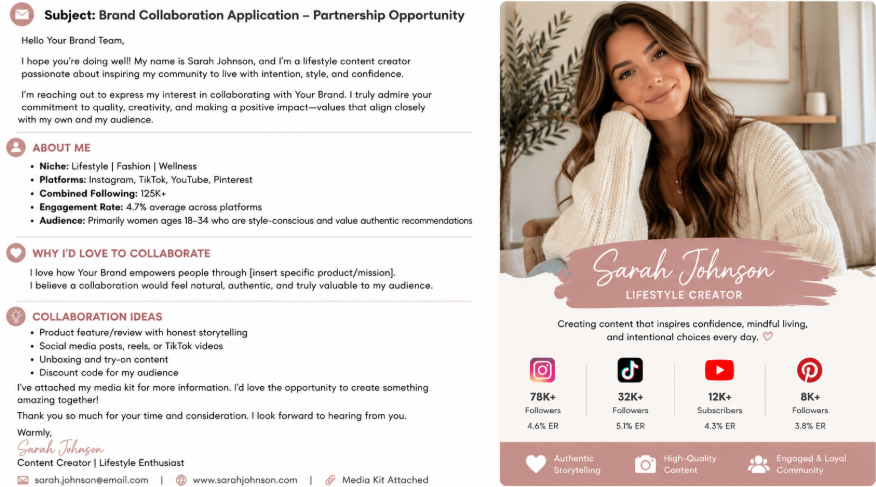
- How ready is your media kit? Before you do your outreach, please ensure your media kit is ready and up to date. This will act as a professional resume showcasing your value, your audience demographics, social/traffic stats, past successful campaigns, and more.
Such a level of preparation will show them that you are serious about the collaboration, rather than just chasing the next paycheck. When you create a pitch that is backed by research, you can position yourself as a credible, thoughtful, and ready partner.
Key Features of a Perfect Influencer Pitch
A good influencer pitch should include these features:
Personalized Message
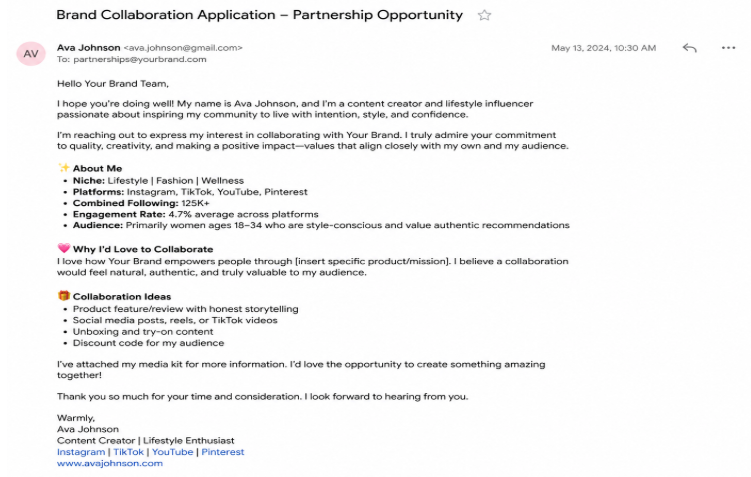
Make sure you explain why you believe in the brand's mission and why you think their products will align with your content. When creating the pitch, it should be addressed to a key member of staff, such as a PR or marketing manager. Share with them why you love the brand and why you would like to work with it. For instance, you can reference their brand value, product, or campaign that aligns with your brand.
Be clear on the kind of collaboration opportunity you are seeking, such as a campaign tie-in, giveaway, or product features, and the content formats and platforms you want to create content for. Share with them how you think your content will add value to their brand and target audience.
It also helps to show you know the rules. Mention that you clearly label sponsored content, for example with the platform’s paid partnership tag, as the FTC requires. Brands want partners who won’t get them into trouble.
Add links to your media and social media kits, as the brand may not take the time to search for them. You can also include an example of your previous content or partnerships showing your product offerings. Take time to check the names and typos in your pitch. If you added any links, make sure they work. If your pitch has clear mistakes, it will be hard to be seen as a serious brand collaborator.
Start with a Strong Introduction Hook
When you are reaching out to brands, you need to make the strongest first impression. Make the introduction confident and friendly. Include details about yourself, and some quick facts to set you apart from the competition. Provide your target brand with reasons to pay attention by being on brand and interesting.
Add a short, interesting hook that shows your creative slide without overwhelming the brand with details. Make your introduction short and clear, highlighting your skills without bogging them down with too many details. When you use a clear, impactful, and thoughtful structure, you will easily capture the brand's attention.
These are tips you can use to make an outstanding hook:
- Make it short and snappy. Ensure it is no more than two sentences.
- Unique value proposition. Consider what will make your band memorable. Is it an impressive statistic, a peculiar project, or a fun fact you can include in a pinch?
- Add a social media link. Include links to your social media platforms or press page as references.
Remember that the goal of an introduction is to spark curiosity, not to list your achievements.
Show Shared Values with the Brand
After the introduction, you can now go to the middle of the pitch, where you can show that your brand has done its homework. You can use this section to showcase your fresh, personalized vision that will help their products perform well. Carefully consider how your content fits within the brand strategy.
You can show a deeper connection with a brand in your pitch using the following tips:
- Show your strength. You might be different from their current colleagues. This can enable you to showcase your unique value proposition.
- Show the value you offer. Even if you are not in the same niche as the brand, you can still show them the value you will offer. Make sure you back up the claims. For instance, instead of saying you have a highly engaged audience, you can add links to some of your top-performing, relevant posts. You should do the same for other metrics, such as click-through rate and dwell time. Remember to provide links to your social media pages, such as Instagram, TikTok, and YouTube.
- Have a professional signature. Ensure your signature is professional-looking, including your name, website link, title, and key links to your social media pages. You can also include a name and a website link.
- Add a CTA. You want to ensure you are clear about what you need to do, rather than leaving them to guess. For instance, “Let me know if I can send you a media kit.” With a good CTA, you can easily double your engagement.
Follow up with the Brand
After a few days of sending your brief, you can follow up with the brand and ensure that you make the follow-up brief. Remind them that you were interested in working with them and show continuous interest. Show you are engaging with the brand on social media. If they recently launched a campaign or a product, congratulate them.
If you are regularly featuring the brand and its products in your content, you can increase your chances of the brand accepting your partnership request. When making a follow-up, be sure to:
- Keep it personal. Ask them for a quick meeting or call to discuss the collaboration opportunity, while showing the value you can offer them.
- Don't pressure them. If they don't respond, thank them for their time while maintaining an open tone for future conversations.
- Think in the long term. Avoid having the mindset that the brand must accept the pitch now. Focus on building a relationship that could lead to something bigger in the future.
- Time to pitch. Pitch during special moments like holidays, upcoming brand moments, or product launches.
- Keep the media kit for future reference. If the media kit brought the desired result, keep a document for future reference.
Remember that the brand collaboration is a long-term affair. Even when you don't hear from the brand the first time, there's an opportune time in the future, such as a product launch. Be persistent and respectful without coming out as pushy. A thoughtful and well-timed follow-up can show your genuine interest and make them consider you for future collaborations.
Common Mistakes To Avoid When Pitching
When creating a pitch, avoid the following mistakes:
- Sending the same pitch to different brands. Instead, make sure each pitch is personalized.
- Asking for free products. However, if you need to use it in your content, then it will be fine.
- Focusing on yourself. Instead of focusing on yourself, focus on the brand, its goals, and its audiences.
- Overpromising. Make sure you promote partnerships you can handle well.
Wrapping Up Your Pitch
Wrap up the email by sharing key information about your brand without overwhelming them. You can add the follower stats, media kits, and key links at the bottom to help the brands explore them further. Make sure these details can be easily scanned so that the brand managers can quickly get the highlights.
In Conclusion
Adding a polished pitch will show your respect for the brand’s time and professionalism. Avoid using unclear messaging or missing important details, as this will make you look unprofessional. Make sure the email signature you are using looks professional, and the message shows your expertise in influencer marketing. But before you start the pitch, grow your Instagram account or any other social media profile.


