Instagram’s growth is all over the place. You put up something you believe is great, and nothing comes to pass. Now you post something fast and maybe almost carelessly, and it does better. It is not consistent and unpredictable, and, to be honest, frustrating.
Most people stop here. They presume growth concerning luck, trends, or post more frequently. And for a moment, it seems that is the case. Some accounts blow up overnight while others stay invisible despite effort.
But then that is what you see on the surface. It has a system behind every account that is steadily increasing. Not a hack. Not a shortcut. A system.
Here is the interesting part. Instagram is not just a content platform. It is a feedback engine. Every post you publish creates signals. Every scroll, pause, save, and share feeds into a pattern.
What most people do is focus on content. The real growth driver is the knowledge of the tendencies in the consumption of the content, and this is where it gets interesting.
Everything becomes different because once you begin to perceive Instagram not as a stage but as a system, your posts stop being random attempts and become deliberate moves.
This guide walks through that shift step by step. From zero to steady growth.
Why Most Instagram Growth Fails at the Start
The greatest error that new people make is that posting is equal to growth. It does not. It is only the entry point to the post.
Think about it this way. When two individuals share the same number of posts per day, one will know what their followers react to, and the other one will not; the results will be totally different. It will be the same effort, but different results.
Here is the underlying issue. Most new accounts are built without clarity. No clear audience. No defined content direction. No positioning. Just posting whatever feels right at the moment.
It feels productive, but it is scattered, and Instagram does not reward scattered signals. The algorithm is trying to categorize you. If your content jumps between topics, tones, or formats, it struggles to understand who to show your posts to, which slows everything down.
Now layer in another problem. Human beings usually attempt to imitate the already trending thing. They imitate styles, patterns, or templates without knowing the reasoning behind them being effective in the first place. So the output looks similar, but the response is different because the intent behind the content is missing.
Clarity beats effort every time. Once you define what your account stands for and who it serves, your content starts sending stronger signals. Instagram learns faster. Distribution improves. And suddenly, growth does not feel random anymore.
Understanding How Instagram Actually Distributes Content
The majority of individuals envision Instagram as a broadcasting site. You put it on, and it will appear before your followers. It is no longer the case.
Instagram operates more like a testing system. Every post goes through stages. Initially, you present your material to a few individuals. Some are followers, those who are not. This is a test phase.
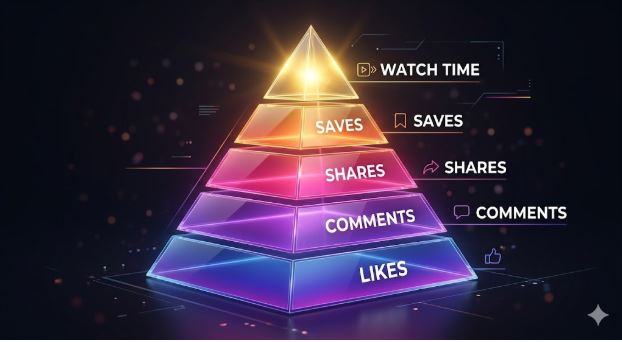
What matters here is not likes. It is behavior. How long do people watch? Do they stop scrolling? Do they save or share? These signals determine whether your content moves forward.
A post that has low likes and high watch time may be better than a post that has high likes and retention. That is counterintuitive. However, it is reasonable once you know the purpose.
Instagram does not want to lose people on the platform, so it prioritizes content that holds attention.
Let us break it down:
Metric What It Signals Why It Matters
Watch Time Attention depth Indicates content quality
Saves Long-term value Shows usefulness
Shares Social relevance Expands reach
Comments Engagement depth Signals conversation
Likes Surface approval Lowest priority
Likes are easy, but attention is not. And that is exactly why attention matters more. So when building growth from zero, your goal is not to go viral. It is to pass these early tests consistently. Once that happens, reach compounds.
Choosing a Clear Content Direction
This is where most accounts either unlock growth or stay stuck—Content direction. Not niche in the traditional sense. Not just "fitness" or "marketing." But a clear intersection of audience, problem, and perspective.
Let us simplify it.
Your content direction answers three questions:
- Who are you speaking to?
- What problem are you addressing?
- How do you approach it differently?
That last part is often ignored, but it matters the most because Instagram is crowded. Two creators can talk about the same topic and get completely different results. The difference is not the topic. It is the angle.
Example.
Instead of "fitness tips," one account focuses on "gym mistakes beginners make."
Same niche. Different framing. Different outcome. Clarity sharpens your content.
When your direction is clear, your ideas become easier to generate. Your messaging becomes stronger, and your audience starts recognizing your content.
Here is a simple comparison:
Scattered Content Directed Content
Random topics Focused themes
Mixed messaging Consistent voice
Slow growth Compounding growth
Weak audience signals Strong audience signals
Direction creates momentum. Once you have it, everything else becomes easier.
Building Content That Stops the Scroll
Instagram is a scrolling platform. That means your content is competing for attention in real-time, and attention is fragile.
If your content does not create an immediate reason to stop, it gets ignored. This is where hooks come in, but not the generic ones.
Effective hooks do one thing well. They create curiosity or relevance instantly.
Example:
"Why are your posts not growing even though you post daily?"
That speaks to a specific frustration. Now compare that to:
"Tips for Instagram growth"
Too broad. Too easy to ignore.
Hooks are not about being clever. They are about being specific. Once you capture attention, the next step is retention.
This is where most content drops off. People get the hook right, but the rest of the content does not hold attention.
Here is what works:
- Fast pacing
- Clear structure
- Progressive value
- No wasted space
Think of your content as a journey. Each second should give the viewer a reason to continue.
Attention is earned, not given. When your content consistently holds attention, Instagram notices, and distribution increases.
Creating a Repeatable Content System
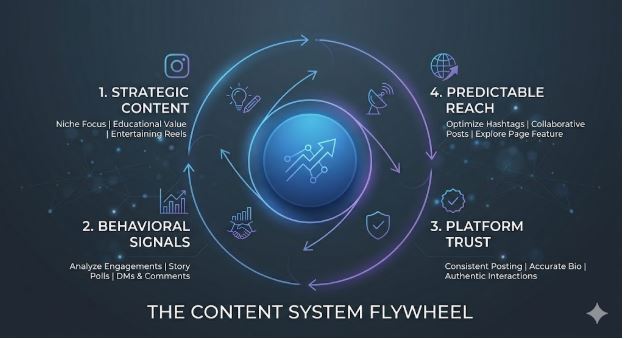
Consistency is often misunderstood. It is not about posting every day. It is about posting with a system. Without a system, consistency leads to burnout. With a system, consistency leads to growth.
Here is how to build one. First, identify your core content pillars. These are the themes your account will revolve around.
For example:
- Education
- Mistakes
- Case studies
- Personal insights
Each pillar serves a purpose. Education builds authority. Mistakes create relatability. Case studies provide proof. Insights build connections.
Now rotate them. Instead of guessing what to post, you follow a structure. This reduces decision fatigue and improves quality.
Second, create templates. Not rigid ones. Flexible structures.
For example:
Hook → Problem → Insight → Example → Takeaway
This makes content creation faster and more focused.
Third, track performance. Look at what works. Not just what goes viral, but what consistently performs.
Systems turn effort into results. Over time, your content becomes sharper, your output becomes faster, and your growth becomes more predictable.
Leveraging Early Engagement to Trigger Reach
When you are starting from zero, early engagement matters more than anything else because it determines whether your content moves beyond the initial test group.
Here is how to influence that. First, focus on your first audience. Friends, network, early followers. These are the individuals who are likely to access your content the most early. Encourage interaction. Ask questions. Create discussion. Make it easy to respond.
Second, optimize timing. Posting when the audience is online would enhance the chances of getting an instant response.
According to Sprout Social’s 2025 analysis of nearly 2.7 billion engagements, social media activity peaks in the evening, especially between 5 and 9 p.m. on weekdays for platforms like TikTok and Instagram, making it easier to capture early engagement when audiences are most active.
Third, develop content to be shared. Content that people want to send to others expands your reach beyond your current audience. Early signals matter. If your post performs well in the first hour, it is more likely to get pushed further.
Here is a simplified flow:
Stage What Happens
Initial Test Small audience sees post
Early Engagement Signals collected
Expansion Content shown to a wider audience
Scaling Potential viral reach
Momentum starts early. Focus on that, and growth becomes easier to trigger.
Understanding What “Steady Growth” Really Means
Most people chase spikes. Viral posts. Sudden jumps. Big numbers. But steady growth looks different. It is quieter, more consistent, and more powerful in the long run.
Here is the interesting part.
Accounts that grow steadily often outperform accounts that go viral once because their audience is more engaged, their content is more consistent, and their signals are stronger.
Steady growth compounds. Each post builds on the previous one. Each follower is more aligned with your content. Each signal becomes stronger.
This creates a loop. Better content → Better engagement → Better reach → Better audience → Better content
And it keeps going.
Consistency creates trust. Not only with your fanbase, but also with the platform itself. When Instagram recognizes your content and sees good performance, then it will share your posts more assuredly. That is when growth starts to feel natural.
Conclusion
Growing on Instagram from zero is not about doing more. It is about doing the right things with intention.
In the beginning, everything feels slow. Posts barely move. Signals are weak. It can feel like you are posting into a space.
That phase is not a failure. It is calibration.
The platform is trying to understand where your content fits, who it resonates with, and how people respond to it. At the same time, you are learning what holds attention, what gets ignored, and what deserves to be repeated.
That is where the shift happens.
Once you understand how content is tested, how attention builds, and how signals compound, growth stops feeling random. It starts to make sense. Patterns become visible. Small changes start producing noticeable results.
It becomes a system. A system you can refine. A system you can repeat. And over time, a system that produces steady, predictable growth.
Not instantly. But consistently. And that is what matters.