
The entire concept of marketing and how businesses reach out to audiences is completely changing, and it’s all thanks to AI being used more in every business’s marketing plan. AI helps brands automate processes which lets them improve on ways to engage customers and obtain data to make better choices.
Nowadays, marketing plans need to be adaptive and very efficient.
That’s why brands are using AI to stay competitive. There are many effective ways to structure marketing strategies. However, a marketing canvas is one that stands out from the rest.
A canvas is like a visual marketing plan. It helps brands map out their plans and segment parts of their strategies which improves on how they reach out to audiences.
The marketing canvas provides a well thought out and clear approach to creating a marketing plan. This ensures that all elements of the plan are aligned. By incorporating AI into this whole procedure, companies essentially improve efficiency by saving their time through AI’s help.
With AI, companies can get deeper insights and create much better campaigns, especially when you consider how AI can make this entire process completely automatic. Sometimes, all you need is a small description of what your plan’s going to look like.
After that, AI takes over and creates the plan for you to edit.
It’s no shock that we’re seeing a big intersection between AI and marketing canvases. But as we talk about this combination of tools, we’ll see how companies can maximize the effectiveness of marketing plans with AI’s help. Let’s see!
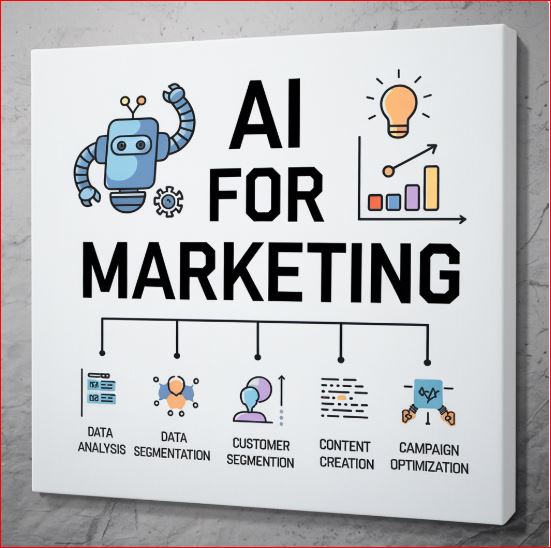
Understanding AI In Marketing
We’re sure you’ve got some idea about how AI is used to create marketing plans. However, having a clearer idea of the background processes helps determine what areas you need to focus on to improve your plans.
In marketing, AI refers to companies and brands using machine learning techniques and automated tools to personalize customer experiences and improve the decisions they make.
With traditional marketing methods, brands need to rely on gathering data manually and trying to overcome any potential human errors when making important decisions, and that can be incredibly time-consuming.
With AI, that’s all done in seconds. AI is created to look over thousands of data sets and sort out patterns from these data sets. It “trains” itself from these data sets to predict trends and repeat common tasks.
With AI’s help, brands can make better campaign choices as they receive tips from the AI itself.
You see, machine learning gets rid of any ineffective practices. What isn’t working, isn’t practiced, and so, the AI just sticks to what works best.
Moreover, AI can also notice subtle shifts in how customers feel. This is something that is practically impossible to do manually considering the subjectivity of the matter. Thus, AI can allow companies to adjust their marketing strategies and messages as sentiments change rather than after they’ve already changed.
Where AI is Used in Marketing
Automated Processes: AI makes processes like sending emails, posting on social media, and replying to customers an automatic process. This allows 24/7 customer engagement, which improves customer satisfaction through instant responses.
Personalization: It helps businesses provide content that’s personal to each customer in the form of targeted ads or recommendations. AI analyzes each customer’s behavior and then provides information, which boosts engagement and customer loyalty.
Predictions: AI trains itself over historical data. This allows it to analyze and predict customer behavior, and allows brands’ marketing plans to be adaptive.
Generating Content: Tools like ChatGPT help in creating social media posts or ads which brands can use as inspiration. The results are obtained in seconds which reduces workload on marketing teams.
SEO Optimization: AI uses search engines to find the most used keywords to analyze user intent. With access to this info, brands can use the keywords in their posts/articles or ads to reach wider audiences.
What is a Marketing Canvas?
The simplest picture of a marketing canvas is to think of it as a physical marketing plan, like a map that allows brands to know where they stand and what they’ve got to do next. This helps brands structure their approach to how they engage with customers and create value for them.
Unlike traditional marketing plans, a marketing canvas isn’t super long or filled with information. It’s brief and easy to follow.
The main benefit obtained through a marketing canvas is the structure of the marketing plan. This allows businesses to focus on what matters the most. By having a physical marketing map laid out in front of them, brands will find it easier to locate gaps or missing info in their strategies.
A marketing canvas is especially useful for newer startups and small businesses that need a clear map to project their growth. Similarly, larger businesses can also make use of this as it allows for clear communication between departments.
When you combine AI with a marketing canvas, it becomes easier to predict market trends and work on strategies in real time. The real time updates allow brands to stay ahead of competitors by knowing when and how customer preferences are changing, or when new trends are popping up.
Popular Kinds of Marketing Canvases
Business Model Canvas: This focuses solely on business strategy. It includes revenue streams and key partners, and allows brands to link marketing efforts to overall business goals, which leads to the efficient use of resources.
Value Proposition Canvas: It helps brands define value propositions depending on customer demands and identify what customers want the most. It allows brands to develop effective messages.
Lean Canvas: It is specially designed for startup businesses and focuses on reiterating and refining business models. It is best for companies that are trying to test out ideas in markets that develop relatively quickly and help maximize success while also minimizing the risk that comes with new ideas.
Brand Strategy Canvas: It helps businesses create strong messages, allows for better brand recognition, and ensures consistency amongst all marketing channels. It is easier to boost trust with customers.
How Does AI Improve Companies Using a Marketing Canvas
Unlike manual work, AI provides real time updates which can help brands with choices they make. Usually, marketing strategies rely more on intuition and assumptions on customer data. Don’t forget that traditional methods don’t have access to complete customer data.
But with AI, businesses can process huge customer data to get insights on their behavior, trends, and general market shifts which is normally extremely difficult to figure out manually.
Through AI tools, brands can get better ways to predict how customers would react to certain strategies. This data offers brands a much clearer understanding of what drives customer choices and how marketing tactics should be adapted to meet their changing needs.
With AI, you can get rid of the whole guessing game and focus more on what customers actually want. Thus, brands can reduce the risks of wasting marketing efforts elsewhere.
The AI’s ability to notice changes in real time data allows businesses to make quick adjustments to their marketing strategies. This is especially crucial considering how fast markets can change nowadays.
Just think of how many brands lose out on customers because of a new discovery made by someone on Twitter.
With AI, brands don’t need long evaluation periods. Access to real time data allows for immediate plan reiteration which is very efficient.
AI doesn’t just help figure out if something’s going to fail. It can also hint at what customers may want next, based on all the data it gathers, although nobody can predict years ahead reliably.
These insights can help businesses to design their approach in a way that focuses on growing success. Sudden changes in the markets? AI can sometimes spot the first signs early. This allows brands to anticipate changes in demand before they actually take effect in the market.
How AI is Used to Create Content For Marketing Strategies
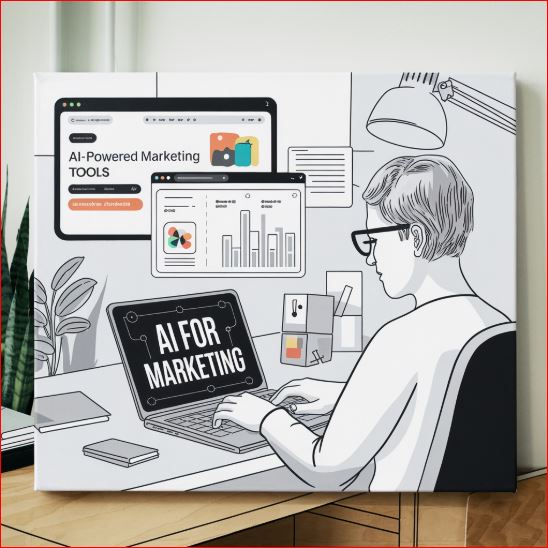
The entire process of content creation is streamlined once brands start using AI tools to their advantage.
A big problem that marketing departments often run into is that it can get difficult to produce high-quality content in large scale operations without sacrificing quality.
But with AI tools, that’s rarely a problem. These tools make use of algorithms like NLP (natural language processing) which helps them understand the context, tone, and style of the content that’s being created.
In turn, this helps create content that actually matters to the audience.
By using AI, brands can create a wide range of marketing materials. From blog posts to articles and social media posts, AI tools can generate this content much faster than human writers/marketers.
AI platforms can also optimize content for search engines which boosts visibility and brings in more traffic. This allows brands to maintain a consistent online presence without overburdening any departments.
Additionally, AI tools also analyze performance metrics and customer engagement data to help improve content strategies. An example is how AI automatically chooses what your headings and formats should be.
These decisions are made based on what generally works the most, and this allows brands to focus on areas with the highest potential for success.
Writer’s block and artist’s block are common problems you’ll see in marketing departments. It gets difficult to come up with new ideas to engage your audiences but AI solves that problem by repurposing already existing content in new ways.
AI tools can repurpose blog posts or long articles into social media posts that can be shared to reach wider audiences. This flexibility ensures that marketing content can be used on multiple platforms, improving the reach and effect.
How Does AI Help Customize a Marketing Canvas For Different Customers
One of AI’s biggest benefits is that it can improve customer personalization and segmentation. Usually, old fashioned segmentation relied on basic demographic data like age, gender, and location.
While these factors provide a lot of valuable insights into your customer base, they don’t provide a full picture of customer behavior and preferences. AI, however, uses ML algorithms to distinguish between different customer types based on wider criteria including browsing history, general purchase behavior, and social media activity.
By analyzing huge datasets, AI can identify unique customer segments with far greater precision. This allows brands to target their marketing efforts more effectively, ensuring that the right message is sent to the right people at the right time.
An example of that is how AI can help companies figure out which customers are more likely to make repeat purchases or send recommendations to other customers. This allows the brands to tailor their efforts to retain these segments.
AI chatbots also do a great job of promoting personalization by offering real time engagement with customers.
Just take a look at ChatGPT.
Each conversation you make with ChatGPT is going to be completely different. And it depends on how you first interact with the AI.
Chatbots built on models like the one behind ChatGPT can analyze user behavior to recommend products based on individual preferences. They can also gather customer feedback and adjust responses accordingly, and this improves the customer experience.
Benefits of Using AI With a Marketing Canvas
It goes without saying that efficiency is largely improved upon with AI-powered tools. These tools automate repeated processes and provide valuable insights to brands to allow them make better choices.
By getting rid of manual processes like data entry, AI allows marketing teams to focus on high value activities that require creativity.
Another powerful benefit of AI is its ability to improve targeting through segmentation. As we just mentioned in the previous section, AI can analyze large datasets to create different customer groups based on patterns. Through this, it predicts future behaviors and allows businesses to create targeted campaigns that align with specific segments of their audience. This allows for high engagement and better conversion rates.
AI also improves the personalization of marketing campaigns by allowing businesses to deliver content based on individual needs. Whether it’s through personalized emails or recommendations given by AI, businesses can create more relevant and impactful plans to build customer trust.
AI tools also allow for marketing canvas optimization by providing real time data on campaign performances. Unlike traditional/manual reviews, AI can keep track of real time data to see what’s working and what isn’t. This allows businesses to make instant changes to their marketing strategies. This adaptability is crucial in today’s highly sensitive and volatile markets.

The Bottom Line
When combined with a marketing canvas, AI can greatly improve the ability to develop adaptable and thorough marketing strategies that align with business goals.
The marketing canvas serves as a valuable tool for keeping track of the key elements of a business plan while AI provides data-driven tips needed to improve and optimize those elements. The result is a dynamic approach to marketing that ensures brands can stay ahead of other competitors.
As AI continues to grow, its impact and role in marketing is going to keep growing. Companies using AI and combining it with marketing strategies are and will be better set to thrive in changing environments.
It’s no surprise that the future of marketing lies in the ability to create and combine data, and AI is the tool that allows brands to do just that.


