
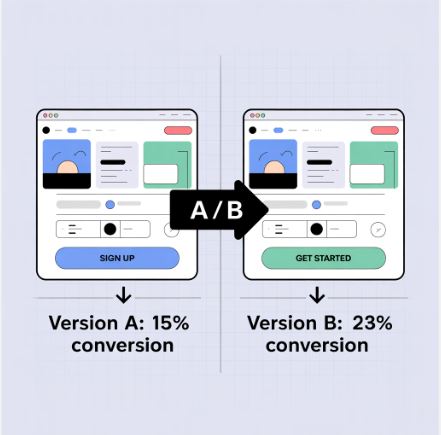
Many marketers often think that A/B is a simple process. After all, it's about comparing element A with B. However, without proper planning, you can have a lot of useless data that adds no value to your social media growth strategy. When you have mistakes in your A/B testing, this can affect your conversion. Fortunately, this article guides you on some common AB testing mistakes to avoid that may impact your conversion.
Common Rookie A/B Testing Mistakes
A well-planned A/B testing will provide you with impactful results. If you are a beginner in social media A/B testing, here are some of the common mistakes you need to avoid:
Not Having a Reasonable Hypothesis
If you are performing an A/B test based on guesswork, this may lead to unreliable results, which can cause much disappointment. A good idea is to begin your A/B testing with a solid and clear hypothesis, a testable statement predicting how changes to one element affect users' behavior.
Here are tips on creating a reasonable hypothesis:
- Check web analytics. Check the pattern of user behavior that you would like to change.
- Understand what’s preventing conversion. Analyze the reasons why users aren't converting.
- Create a hypothesis statement. This should be clear on the tests you are conducting and their importance.
Some of the questions to help you get a better hypothesis are:
- Who are the visitors to my landing pages?
- What are the sources of my landing page?
- Why are the visitors here, and why are they interested in my product offering?
- What can I do to convert the visitors to my site? Is it to write better scroll-stopping Instagram captions?
Not Segmenting Your Audience
Another A/B testing mistake you may be making is failing to segment the different demographics in your A/B test. You may be tempted to rely on the overall conversion rate, but this may provide you with misguided and skewed results, causing you to have unqualified leads and wasted resources. When you focus more on the overall CTR, you will be ignoring the nuances of the diverse audiences.
If you aren't segmenting your audiences, you might be optimizing for visitors outside the primary target audience, which could be reducing your conversion rate. Segmenting your audience is essential, as different segments have different habits. Some of the various segments you can have are new visitors, mobile users, returning users, and more. All these have different user behaviors and preferences.
Here are several tips on audience segmentation:
- Create or identify landing pages. Whether your goal is to create a new landing page or use an existing one, ensure that you can test it.
- Determine the criteria for segmentation. Use your hypothesis to determine your audience segmentation using segments such as behavior, demographics, and device type.
- Set up your marketing list or ad level. Ensure that you have a subset to test run on. This can be important for gathering the necessary data.
Focusing on a particular audience segment can yield important insights, resulting in more effective optimization.
A/B Testing Pages with a Few Users
If you have a few followers, you will end up with unreliable A/B testing results because it will be hard to hit the statistical significance. Most marketers aim for 95% statistical significance. That means if there were no real difference between the versions, you'd see a gap this big less than one time in 20. You can leverage a sample size calculator to measure your traffic and conversion. If your visitors are few, you are better off using other methods such as heatmaps and surveys.
Forgetting the Connectivity of Customers
The normal A/B testing methods assume that customers don't influence one another, but this isn't the case in the real world, where users interact with one another, share their experiences, and even impact one another's buying decisions. Such interactions can negatively impact your results, leaving you with misleading data.
If the first group raves about the elements you are testing on social media, they might influence your next group, affecting the testing results. If you ignore the results, you might be left with flawed and inaccurate conclusions. Therefore, if your test results are based on some isolated user data, you might be underestimating the impact of social innovations on data.
You can use network A/B testing to measure group interactions or even altogether avoid them. Here are ways to do that:
- Isolate the test groups. Make sure that users in both groups don't interact with one another. You should create separate communication channels or environments for the different groups.
- Analyze the network effects. Ensure you are using tools that allow you to track the extent of group interaction. Track users' influence on one another so that you can adjust your strategy accordingly.
- Social Influence adjusting. While it is not possible to isolate users completely, social influence should be considered in the results analysis. Look for patterns indicating cross-group interactions and ensure that you are adjusting conclusions accordingly.
- Monitor your social media channels. Use social media platforms to learn people’s sentiments about different groups.
When you account for the interactions, you will gain a better understanding of the users' behaviors, resulting in better and more reliable optimization.
Assuming Testimonials Are a Magic Bullet
Many brands assume that adding testimonials will increase conversion even before testing them. However, despite their usefulness, it's essential to test testimonials to ensure that they are great for your current context and audience. Whatever you test, only use real testimonials from real customers, and say so if someone received something in return for theirs.
A good idea would be to give testimonials the same weight as other kinds of content. Test them in different formats, styles, and placements to determine what resonates with your audience.
- Rigorously test testimonials. Just because testimonials are trusted elements doesn't mean they should not be A/B tested.
- Try different variations to determine which one will work best.
- Track the impact using analytics to determine the actual effect.
Losing Your Company’s Voice
While trying to increase your conversion, you can easily lose your brand's unique voice and personality. If you are over-optimizing for conversion, you can impact your brand's unique selling point, causing you to be disconnected from your customers.
Ensure that there is a good balance between conversion optimization and brand voice preservation. Use the following tips to have a good balance between brand personality and driving conversion.
- Maintain your brand voice. Avoid sacrificing your brand identity for higher conversion rates.
- Test tone and language. Ensure you have a good balance between audience engagement and conversion optimization.
- Quality conversion optimization. Ensure you are optimizing for leads, aligning with brand values, and long-term potential.
Running Short-Term Tests
We understand how hard it can be to wait. However, if you run the test for a short period and then stop it, you will be left with half-baked results. Since you will not have enough time, you will lack enough statistical significance. It's essential to remain organized and keep testing until you reach the 95% significance mark.
Running Many Tests at the Same Time
If you are running too many tests at the same time, this may negatively impact your results. While you can test different variations on one element, running many tests at the same time requires bigger sample sizes and leaves you with a complicated analysis.
A good idea would be to limit the number of tests your team can handle and pay attention to essential elements such as scroll-stopping Instagram captions, outstanding headlines, or perfectly crafted CTA buttons. When you streamline everything, you will end up with some more precise and actionable insights.

Final Thoughts
A/B testing can improve the performance of your social media campaign by providing you with data-driven insights into the preferences of your audience. It offers science-based evidence that helps brands make better business decisions and refine their marketing strategies.
However, inevitable mistakes can impact the effectiveness of your social media A/B testing. Therefore, make sure you understand and avoid the above errors before starting your social media A/B testing.


