The first thing most marketers notice about YouTube Shorts is how fast everything moves. Videos are short. Feedback is instant. Results feel unpredictable.
One post takes off, and another disappears without a trace. It creates the illusion that Short's success is chaotic, almost random, like you are rolling a dice every time you hit publish.
That assumption is where most strategies go wrong because underneath that speed, there is structure. A very specific kind of structure. One that does not behave like traditional content platforms, and does not reward the same instincts that worked on feeds built around followers.
Short-form video has quietly reshaped how platforms pick what gets seen. It is not about who you know anymore, or even how many people follow you, at least not in the way most assume. It is about how well your content holds up under rapid testing cycles, where the platform watches how people behave second by second.
According to DataReportal, users now spend significantly more time on short-form video platforms than on most other social formats, which gives systems like Shorts more behavioral data to work with in less time. That speed changes everything.
Here is where it starts to shift. Look at Shorts through behavior instead of reach, and a different pattern shows up, not instantly, but quickly enough. One that explains why smaller creators suddenly outperform established brands. One that explains why imperfect videos often travel further than polished ones. And one that forces marketers to rethink what “good content” even means.
This article is not about tips. It is about the mechanics underneath the tips because that is where the real leverage is.
Why Low-Like Videos Often Outperform High-Like Videos
Here’s a simplified, made-up comparison of two Shorts to show the idea:
Metric Video A Video B
Likes 20,000 300
Avg. watch duration 9 sec 18 sec
Completion rate 42% 94%
Rewatches Low High
Reach outcome Stalled Expanded
A clip sitting at 200 likes can beat one with 20,000, more often than people expect. That sounds wrong at first.
Picture a personal trainer who posts a 19-second video about one common push-up mistake. It gets a few hundred likes in the first hour, while a flashy transformation montage from a big fitness brand pulls in thousands. By the next day, the smaller video can easily have overtaken it in reach, because people watched it to the end.
The reason lies in how Shorts evaluates content. Likes are visible. Retention is not.
Shorts does not treat a like as a strong signal on its own. It treats it as one piece of a larger behavioral pattern. The duration of sticking around, whether or not one loops it, whether or not one pauses or merely moves on, is what actually carries weight.
A video that keeps the attention span of 18/19 seconds conveys a more significant message compared to a message that receives a like in 4 seconds and then loses its audience in the middle. The usual engagement hierarchy gets inverted, almost quietly.
On traditional platforms, visible engagement metrics often lead performance. On Shorts, invisible behavior leads, and visible engagement follows later.
Here’s the interesting part… A small creator has an advantage here.
Smaller accounts tend to produce more focused, less overproduced content, and the pacing is tighter. The message is clearer, and there is less filler. That often leads to stronger retention, even if the video looks simpler.
You can test this yourself. Make two versions of the same message: one heavily edited with transitions and background music, the other a direct-to-camera explanation shot in one take. Quite often it’s the simple one that holds viewers longer and travels further.
The implication is uncomfortable for many brands. Polish can dilute clarity. And when clarity drops, retention follows.
The First Three Seconds Are Not About Hooks, They Are About Orientation
Most advice about Shorts focuses on hooks. Grab attention fast. Shock the viewer. Start with something unexpected. That advice is incomplete.
Watch a high-performing Short carefully, and you will notice something subtle. The opening is not just grabbing attention. It is helping the viewer understand what they are looking at within seconds.
Orientation beats curiosity. Say a cooking video opens on a simple frame: ingredients already laid out, camera steady, no dramatic intro. Viewers know right away what’s about to happen, so they stay.
Compare that with a dramatic opener full of text overlays and quick cuts. The content can be the same, but more people swipe away.
The difference is not creativity. It is a cognitive load. When viewers cannot quickly understand the context, they hesitate. That hesitation often leads to a swipe.
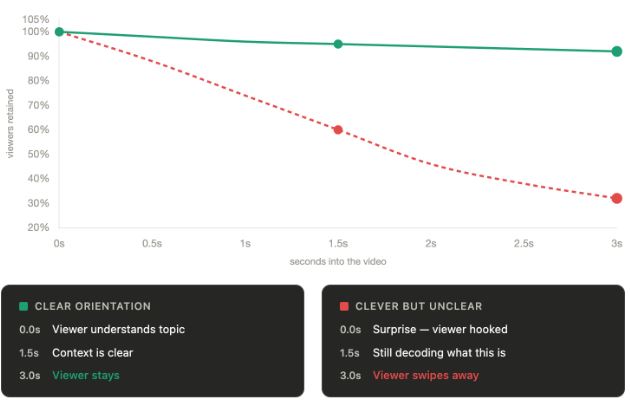
According to Clippie.ai’s 2026 short-form video analysis, videos that promise and deliver a specific benefit in the first 3 seconds achieve 44% higher share rates and far stronger retention curves than those relying purely on intrigue. That aligns with what platform data shows through early drop-off patterns, but that is only part of the story.
Orientation also builds trust. When the viewer knows what they are about to get, they commit more easily to watching. That commitment improves retention, which improves distribution.
A creator who opens with “Here’s how to fix this one mistake in your resume” signals value instantly. No confusion. No guessing. The platform rewards that clarity.
Marketers who obsess over making the first three seconds clever often miss this. The goal is not to impress. It is to anchor the viewer. And once anchored, the rest of the video has a chance to work.
Shorts is Not Distribution, It is Testing
Think about how most marketers approach posting. They publish content and expect it to reach their audience. Success feels tied to how many people see it. That model does not hold on Shorts.
It’s common for someone posting a Short every day for a month to see most of them stall early, then have one suddenly break out. The audience didn’t grow overnight, and there was no paid push. What changed was the outcome of the test.
Shorts operates more like a rapid testing system than a broadcast channel. Each video is shown to small groups first. The system watches how those groups behave. If the signals are strong, the video expands to larger groups. If not, it stops.
What most people don't realize… Every video is essentially an experiment. This changes how consistency should be understood.
Consistency is not about maintaining visibility. It is about increasing the number of experiments you run. More experiments raise the odds of hitting a strong signal pattern. That is why creators who post often tend to outperform those who show up occasionally, even when the videos look rougher. They generate more data, and the system learns faster from them.
A small brand might try this by swapping one highly produced video a week for five simple Shorts. More videos means more tests, and more chances that one of them catches on.
The insight here is strategic. Volume is not about flooding the feed. It is about increasing the surface area for discovery.
Imperfection is Not a Style, It is a Signal
Raw videos outperform polished ones more often than expected. That has been repeated enough to sound like a cliché, but the underlying reason is rarely discussed. It is not about authenticity as a concept. It is about signal alignment.
Highly polished content often resembles ads. Viewers have learned to recognize that pattern. When they do, their behavior changes. They become more likely to skip, even before processing the content fully.
Think of a dentist who films a quick phone explanation of a common dental myth. No lighting setup, no editing, just a casual conversation. A video like that often beats a professionally shot clinic promo, because it fits the feed.
Shorts are designed for rapid consumption. Content that feels native to that environment blends in. Interruptive content is memorable, but not in a manner you desire. Here, the trend begins to change.
Imperfection increases perceived accessibility. Viewers feel closer to the creator. The barrier between “expert” and “person” lowers. That shift changes how long they stay.
But there is a limit. Not all imperfections work.
Suppose the video is unclear, poorly framed, or hard to hear; retention drops. The goal is not to remove quality. It is to remove friction.
There is a difference. And marketers who understand that difference stop chasing polish and start optimizing for watchability.
Audience Building on Shorts Does Not Follow Traditional Logic
A creator goes viral. Their follower count barely moves. This confuses a lot of marketers. On most platforms, reach and followers are tightly linked. On Shorts, they are loosely connected.
A Short about a simple budgeting rule can reach hundreds of thousands of people and still bring only a modest bump in subscribers. Why?
Shorts runs content-first, not creator-first. Viewers engage with individual videos without really attaching to the person behind them. The platform leans toward matching content to interest instead of building long-term audience ties, at least early on.
This creates a different kind of funnel. The top of the funnel expands rapidly through Shorts, but conversion to followers requires something more. A reason to return.
Some creators solve this by building recognizable formats. A specific way of explaining things. A recurring structure. With enough exposure, the viewers begin to notice the pattern and trace it back to the creator, albeit not at once. That recognition drives follow-up behavior.
A language tutor who opens every Short the same way (a quick phrase, its translation, a real-life example) gives viewers a pattern to recognize. Over time they start expecting that format, and that’s usually when subscriber growth picks up.
The implication is not difficult to miss, yet it does matter. It is not through going viral that Audience growth on Shorts comes. You build it by becoming familiar. And familiarity requires repetition, not just reach.
The Algorithm is Not Predicting Virality, It is Responding to Behavior
Many marketers still talk about “cracking the algorithm.” As if there is a hidden formula that, once understood, guarantees performance. That framing misses how Shorts actually works.
Two travel Shorts filmed in the same place, in the same style and at the same length, can perform completely differently. The difference lies in how the first viewers react.
Shorts does not predict which video will go viral ahead of time. It reacts to how viewers behave in real-time. It expands distribution when signals are strong and pulls back when they are not.
This makes the system adaptive, not deterministic. It also makes outcomes harder to predict but easier to influence. You are not able to dictate who watches your video first. The only thing you can do about it is to make it so clear, so interesting to watch, and so easy to watch. And that affects behavior.
That’s why it pays to study retention graphs rather than view counts. They show you what to change.
The lesson is not about gaming the system. It is about aligning with it. And alignment comes from understanding that the algorithm is not a gatekeeper. It is a mirror.
Why Looping Behavior Quietly Drives Distribution
A video that gets watched twice often beats one that gets watched once. That behavior rarely shows up in surface metrics. You will not see it in likes or comments, but it shows up clearly in how far a Short travels.
Take a 12-second clip showing a simple desk setup trick. No call to action, no hook in the usual sense, just a quick demonstration that loops seamlessly.
Viewers reached the end and did not realize it was over. It restarted. They watched again. Retention crossed 100 percent. This is where things get interesting.
Shorts does not just measure whether a video is completed. It measures how much total watch time it generates relative to its length. When viewers rewatch, the signal strengthens dramatically. A 12-second video, when viewed twice, results in more watch time than a 20-second video when viewed once, which is initially surprising.
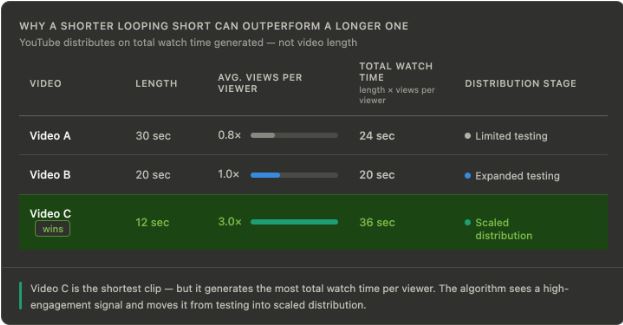
That changes how content should be structured. Instead of thinking in terms of “telling a complete story,” high-performing Shorts often create a slight gap. Something that feels just incomplete enough to trigger a second viewing. It could be pacing, visual detail, or a quick reveal that encourages replay.
You can test this too. Make one version that explains everything clearly in one pass, and another that moves a little faster and leaves out one explanatory line.
The second version will often get more rewatches. It isn’t clearer, but the small gap nudges people to watch again to catch what they missed. Not all clarity needs to show up immediately, though most people assume it should.
Some of it can be delayed. And when done carefully, that delay increases total watch time without hurting comprehension.
Marketers who understand looping behavior stop thinking only about completion rates. They start thinking about replay potential because in a system driven by watch time, a second viewing is not a bonus. It is a multiplier.
Why Topic Selection Matters More Than Execution in Early Testing
Two equally well-made videos can perform completely differently based on the topic alone. Execution matters, but only after a video passes its first test.
Imagine posting two Shorts on consecutive days. One explains a niche tax strategy for freelancers, the other a simple saving rule anyone can use. Both are clear and well paced, but the broader topic is far more likely to scale.
Shorts testing begins with small audience samples. The system needs enough positive signals to expand distribution. If the topic is too narrow, the initial audience pool is smaller, and the probability of strong signals drops.
This is not about going broad for the sake of it. It is about entry points.
A niche idea can still perform, but it often needs a wider frame to pass early testing. The same tax strategy could be reframed as “one mistake freelancers make with money,” which increases relevance without changing the core idea.
And this is where things get interesting. Topic selection determines the ceiling of your video before execution even begins.
Try it across a batch of Shorts: keep the structure and delivery the same and change only how you frame the idea. Broader framing tends to win more initial reach even when the content inside is similar.
Once a video passes the first testing layer, execution takes over. Retention, pacing, and clarity determine whether it expands further. But if it never passes that first layer, execution never gets the chance to matter.
The implication is strategic. Marketers often focus heavily on how content is made. They spend less time on how the content is framed.
On Shorts, framing is not a creative choice. It is a distribution lever because the system cannot reward what it cannot test at scale. And scale begins with relevance.
Conclusion
What Shorts data is revealing is not just a shift in format. It is a shift in how attention is earned. The patterns are consistent once you look closely:
- Retention outweighs visible engagement
- Clarity beats cleverness
- Volume increases discovery odds
- Imperfection can improve alignment
- Familiarity drives audience growth
None of these is a new idea in isolation. What is new is how tightly they are connected within a system that tests content continuously and rewards behavior, not intent.
For marketers, this creates both pressure and opportunity. Pressure, because traditional instincts built around polish, planning, and control do not always translate. Opportunity, because the barrier to performance has lowered.
A single well-structured video can outperform months of campaign planning, but only if it holds attention. That is the throughline.
Not trends. Not hacks. Not timing alone. Attention.
And the marketers who learn to design for that, not just chase it, will find themselves consistently ahead, even in a space that looks unpredictable from the outside.