Dropshipping is becoming increasingly popular in e-commerce and offers retailers the theoretical opportunity to enter the mail-order business, sell their items or expand their business without large investments in warehousing and logistics. Does it work in practice? Is dropshipping a simple solution to more sales, and what is behind the business model?
What types of dropshipping are there?
Dropshipping exists in different forms, whereby basically between the fulfilment from a wholesale and Consignment warehouse must be distinguished. Sometimes the term "commission business" is brought into play, but this is wrong. Here an online retailer sells goods for a third party and receives a commission. This has nothing to do with dropshipping. You have to be able to differentiate between two dropshipping variants:
Case 1: Fulfillment via wholesale warehouse
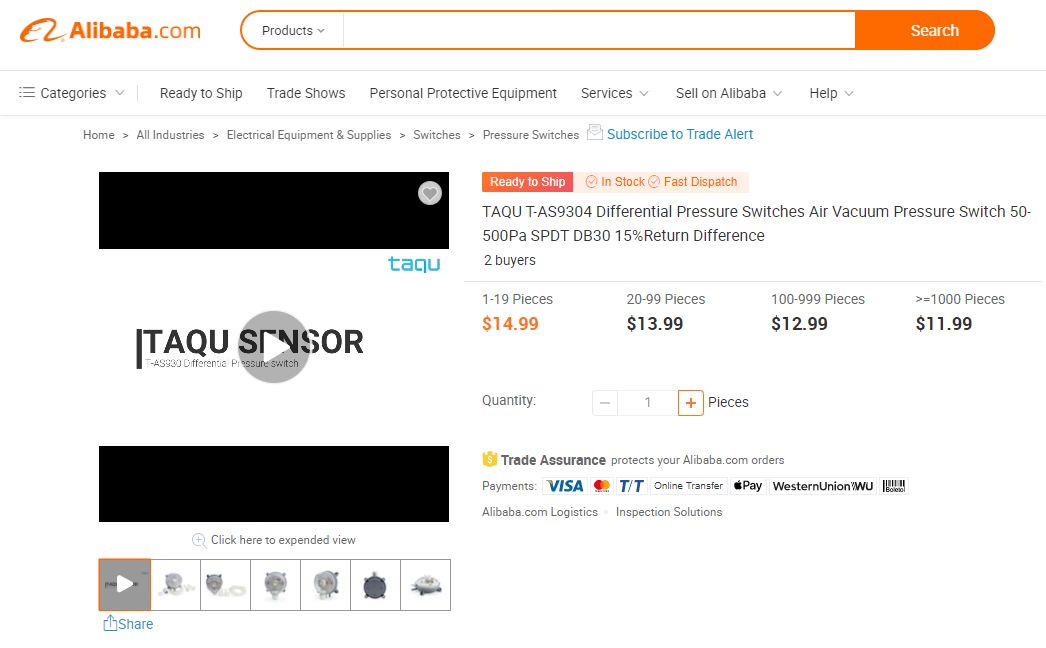
With this variant, the online retailer can fall back on the wholesaler's whole range. However, this only applies if sufficient stocks are available. If the drop shipper has products in his online shop that are no longer available in the wholesaler's warehouse, the order can no longer be executed. With this model, the retailer bears both his purchasing and shipping costs (biggest wholesale platform is Alibaba indeed. Check the image below - this company is one of the wholesale warehouse owner and as you see, they have different price and it depends on the quantity of product you buy).
Case 2: Fulfillment via consignment warehouse
The term "consignment warehouse" traditionally means that a wholesaler sets up a warehouse on the premises or in the vicinity of his customer, whereby the ownership of the goods does not pass to the customer until the item is removed from the warehouse. This is a little different with dropshipping. Here, a wholesaler sets up a separate storage area for the online retailer in its central warehouse. The retailer benefits from a secure supply of goods, as the stocks are kept exclusively for him, and therefore no third party has access to them. However, this is often associated with additional costs or certain purchase obligations.
What does dropshipping cost?
Dropshipping is, of course, associated with costs for online retailers. Mention should be made in particular
Shipping charges
Handling fees
Surcharges for small quantities
The shipping fee area is relatively transparent. Here, only standard shipping costs are estimated. Wholesalers usually fall back on parcel services special conditions, which results in favourable conditions.
Handling fees, sometimes also called "pick and pack fees", are usually due per item. They cover the cost of the picking and the packaging of individual shipments.
You may also be confronted with surcharges for small quantities. This is a relatively widespread practice among wholesalers, who use it to protect themselves against small orders. This minimum turnover is not unusual.
Advantages and disadvantages of dropshipping
In e-commerce circles, dropshipping is seen by many companies as an opportunity to get into online trading in a short time, without investments or special knowledge. There is partly the belief that "everyone" can build a passive income through fulfilment.
However, this is by no means the case! Just because a specific shipping method is used, this does not mean that a trading company's further challenges are eliminated, and therefore no know-how is required.
What are the advantages of dropshipping?
As the previous section shows, dropshipping has several advantages:
First of all, there is no need to buy and store expensive goods, saving your capital.
Also, you save storage space and warehouse staff.
You don't have to worry about logistics either.
Besides, there is no risk of being stuck with unsold stock.
Another advantage is that you can set the profit margin yourself in many cases. Although some dropshipping providers set minimum prices, there is theoretically no upper limit, except for your customers' price sensitivity.
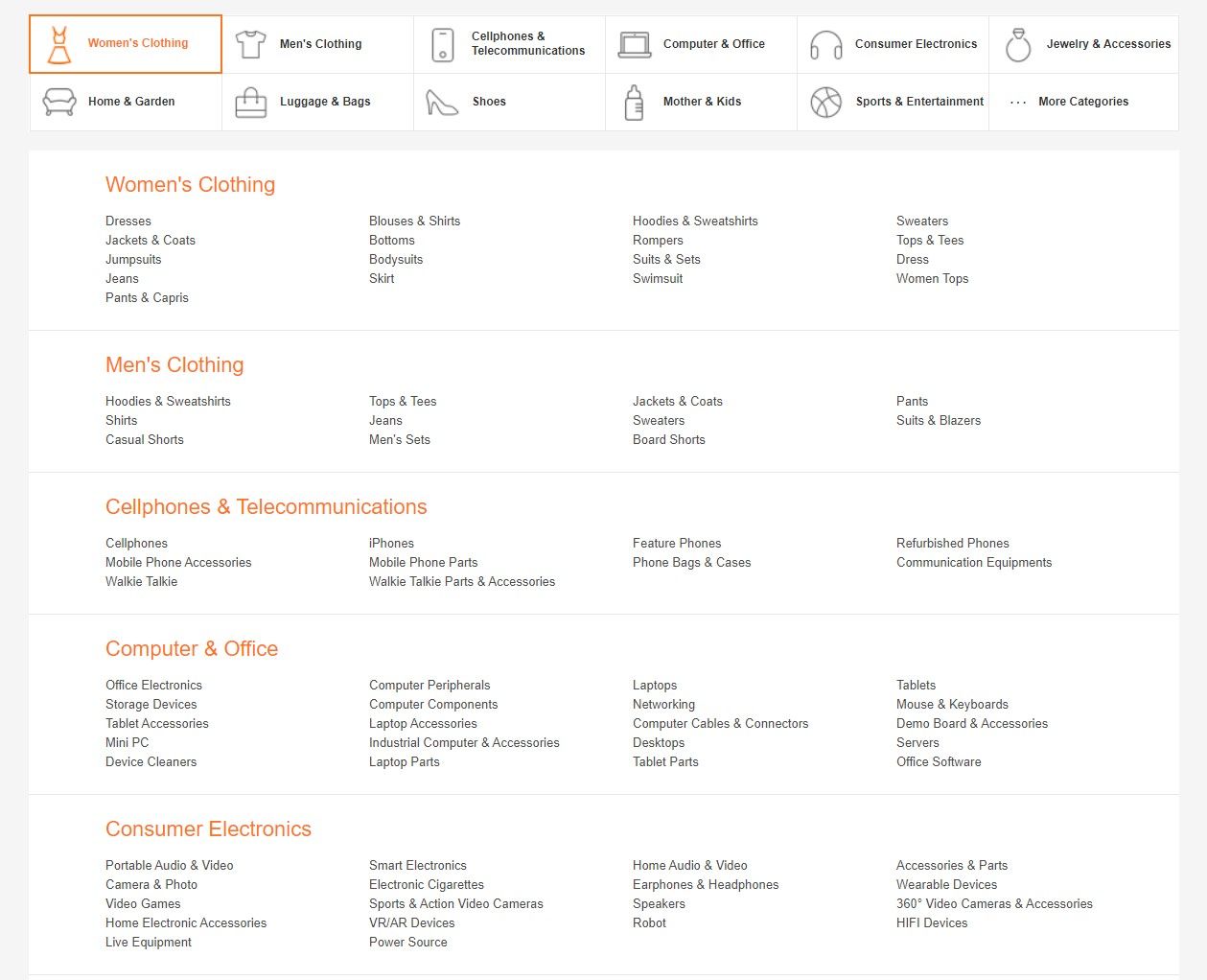
Another plus point is the excellent scalability. You can expand your range in a short time with dropshipping, operate internationally and usually cover order peaks without any problems (check the image below - it's a sneak peak of categories on Aliexpress, biggest dropshipping source - you'll see that Aliexpress has thousands of categories, so you can easily scale the business).
What are the disadvantages of dropshipping?
Where there are advantages, there are naturally also disadvantages. It doesn't always make sense to build an online business purely based on dropshipping for various reasons. To sum up, dropshipping is particularly advantageous in terms of investment requirements and scalability. On the other hand, there are some disadvantages, the main ones to be mentioned are:
low margins
low level of customer focus
Loss of control over one's products


