

An Edelman's Trust Barometer report indicates that 52% of consumers suggest they would trust employees' information. The report further notes that in nearly four out of five business-related topics, such as integrity, engagement, operations, and services, employees are usually the most trusted. This suggests that employee advocacy can be a highly effective strategy for enhancing brand awareness.
When you establish an employee advocacy program, you can be confident that employees have the necessary guidelines, training, and messaging to engage both new and existing customers. Those guidelines should also tell employees to say they work for the company when they share its products, because the FTC expects that connection to be disclosed. One of the essential steps in an employee advocacy program is tracking the campaign's effectiveness. In this article, we will guide you on the key metrics you need to track in an employee advocacy program.

What Does Tracking Employee Advocacy Success Entail?
Tracking employee advocacy means evaluating the program's impact using various key performance indicators (KPIs). You need to ensure you track the impact of key performance indicators and how brands can use them to achieve meaningful results. Therefore, you will need to use metrics that show you:
- Brand reach and visibility level.
- Employee participation.
- Engagement.
- Business impact.
When you track results, you can turn those fluffy numbers into real evidence. When you obtain proof, you can demonstrate to administrators why advocacy truly matters. Additionally, having the right tools can improve your strategy and enhance the entire advocacy program.
Why Track Employee Advocacy Success
Tracking the success of your employee advocacy can help you demonstrate the returns on investment to leadership, ensuring intelligent optimization and motivating your employees. If you are a business, tracking the results will ensure:
- Accountability. When running an employee advocacy program, you will likely receive many questions about whether it's bringing the recruitment, leads, and reach necessary. If you track and provide complex, cold numbers, you will provide more evidence than a social media post with many likes.
- More effective strategy. Tracking the results of your campaign will provide insights into what is working and what isn't, so you can focus on what is working and reduce what isn't.
- Building momentum. Having data can turn that one-off experiment into scalable and repeatable engines for growth.
If you are an employee advocate, measurement can help increase momentum and trust in different ways, such as:
- Real results. You can demonstrate to brand advocates that the posts are positively impacting the business.
- Personal wins. Achieving real results can demonstrate that team members have expanded their online network and presence through the business advocacy program.
- Sharing success. Ensure that you share results transparently, so employees feel they are contributing to a larger shared goal.
By measuring advocacy, you can focus more on what truly matters. If a post gets thousands of likes, you will feel great. However, if that doesn't translate into qualified leads, top talents, and customers, there is no point in it.
Key Employee Advocacy Metrics to Track
The metrics you track will depend more on what you want to achieve. This can include various metrics such as:
Reach and Awareness Metrics
You need to determine if the employee content is enhancing your brand’s visibility. The best metrics to answer this question are those related to share of voice, impressions, and reach, which indicate how your brand messaging is being disseminated.
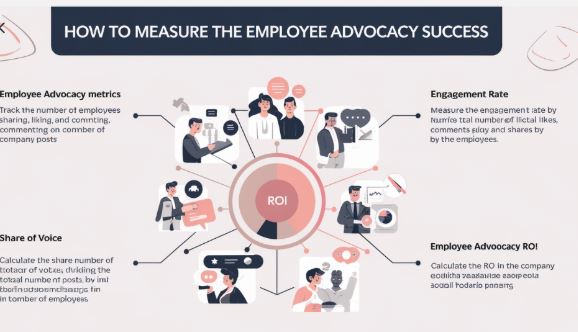
Consider how you are communicating your awareness and reach metrics. For instance, instead of just saying that content shared by our employees reached 50,000 people, you can add something like “that helped us save $10,000 we would have used in paid impressions.”
Engagement Metrics
Are people interacting with the employee advocacy program? If the answer is yes, you need to track comments, likes, click-through rate, and sentiments resulting from the advocacy content. This will demonstrate that employee advocacy can lead to more authentic engagement compared to branded posts.
According to the data, employee advocacy is a crucial tool for driving engagement. A LinkedIn report suggests that when employees share a piece of content, it results in twice as much engagement compared to content shared by a brand.
Recruitment Metrics
You need to determine if the employee's content is effective in attracting others to your organization. If the top talents see the advocacy posters highlighting what it takes to work for the company, this is likely to lead to more applications. Take the time to review the application pool of your potential candidates and assess whether the quality of new hires has improved.
Employee Uptake Metrics
You need to determine the employee advocacy program's uptake. When you understand the percentage that distributes the content, you can get a clearer picture of the traffic, including where you are sharing numbers and engagement. If you find this number to be small, you can use the data to consider how to offer more incentives to employees joining the program.
Consider the number of employees participating in the program and the average share rate for each employee. This will help you determine if advocacy is a key part of your company. For instance, if half of your workforce is engaged in thought leadership, that indicates a reasonable participation rate.
Lead Generation and Sales Metrics
You want to determine if the advocacy is resulting in increased traffic. You can achieve this by monitoring leads, conversions, and their impact on your bottom line. These metrics will demonstrate that employee advocacy is delivering tangible returns and is not just a feel-good project. By engaging in an employee advocacy program, salespeople can find that they convert more.
Content Getting the Most Shares
You need to identify the type of content employees feel more comfortable sharing. Also, consider the content that seems most effective for your brand's goal. Once you receive answers to these two questions, you can determine which content resonates more effectively with your target audience.
This can also provide essential insights into the share rates and the content generating those shares. This information will help you diversify your content and focus on the types that generate the most shares.
Employee Retention
When employees take pride in your brand, it can lead to greater loyalty. When your employees feel that you value them, they are more likely to commit to working for the company in the long term. When you see that your retention rate has improved after an advocacy program, this is a sign that the employees' loyalty and pride are already increasing. This can then be tied to the program as the money you saved from the exercise.
In Conclusion
Like any other social media marketing strategy, you need to track the performance of your employee advocacy program. This can provide insights into what is working and what isn't. You can then use the data to optimize your campaign. By following the steps outlined above, you can effectively track the campaign's performance. You can read our guide on crafting the perfect LinkedIn profile.


